Quick answer: First identify the ordering system: table service, a touchscreen kiosk, a table tablet, or a QR menu. Check portions and required options before confirming. In many Korean restaurants, you pay at the counter when you leave rather than asking for the bill at the table.
Quick answer: how ordering usually works
- Table service: Sit down, check the menu, and use the call button or say “Yeogiyo” to get a server’s attention. In Korea, restaurant servers usually do not approach your table first to take your order. Once you have decided what to order, it is perfectly polite to call out “Yeogiyo” (“Excuse me”) to get a server’s attention.
- Counter service: you pay at the counter after finishing your meal. Unlike in many other countries, you generally do not ask the server to bring the bill to your table. Simply walk to the counter when you are ready to leave.
- Touchscreen kiosk: Choose the language if available, select dishes and options, then pay at the machine. Some restaurant kiosks are used only for placing orders and do not have a card payment slot. In that case, complete your order at the kiosk, enjoy your meal, and pay at the counter before leaving.
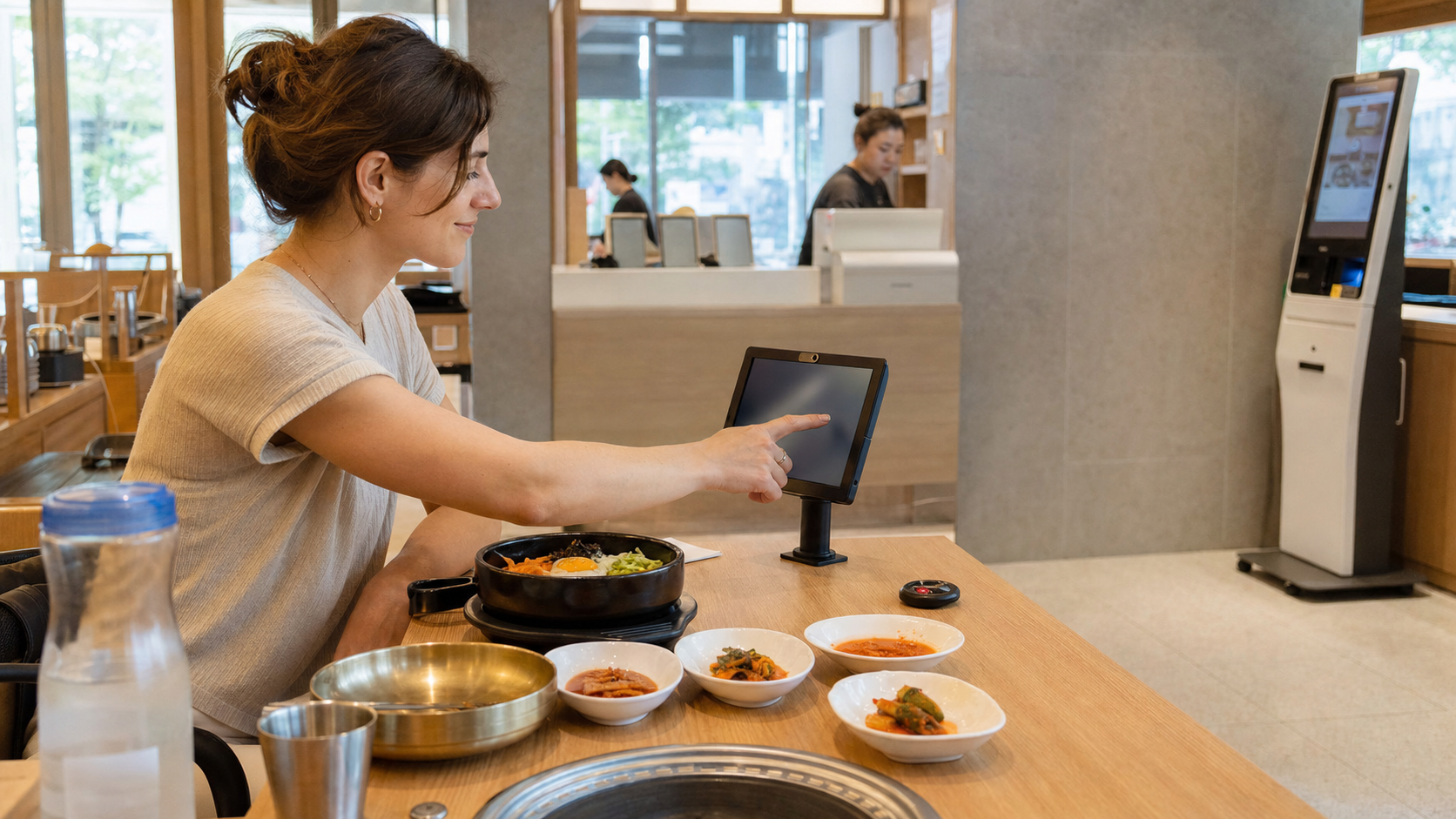
- Table tablet or QR menu: Add items on the screen and confirm the order; If there is no card payment slot, payment may happen later at the counter.
- Self-service: Water, cutlery, side dishes, or the tray-return area may be marked “self.”
The system varies by restaurant, so watch what other customers do and look for signs near the entrance. If you are unsure, showing the menu item on your phone or pointing politely is usually enough to start.
1. Check the menu before you order
Many restaurants display a menu outside, sometimes with photos and prices. Inside, the menu may be printed, attached to the wall, shown on a tablet, or available through a QR code. English is common in busy visitor areas but is not guaranteed.
If the menu is only in Korean, use your phone’s camera translation as a starting point. Translation can miss ingredients and cooking terms, so confirm anything important—especially allergens, meat or seafood broth, alcohol, and spice level—with a staff member.
2. Ordering at a table-service restaurant
At a typical sit-down restaurant, wait to be seated unless the layout clearly suggests choosing your own table. Menus, spoons, chopsticks, and napkins may already be on the table or stored in a drawer underneath it.
- Choose the dishes and check whether the price is per person, per portion, or for a shared set.
- Press the table’s call button if there is one. Otherwise, say “Yeogiyo” (“Excuse me / Over here, please”).
- Point to the item and show the quantity with your fingers if pronunciation is difficult.
- Repeat or check the order on the server’s device before they leave.
- At the end, take the table number or bill slip to the counter unless the server brings a payment terminal.
Barbecue restaurants and some set-menu restaurants may require a minimum order, often based on the number of diners or portions of meat. Check the menu rather than assuming that one listed portion is enough for the whole table.
3. Using a restaurant kiosk
Self-order kiosks are increasingly common in fast-food restaurants, cafés, food courts, and casual chains. The exact screen differs, but the basic sequence is similar:
- Choose dine-in or takeaway.
- Look for a language button, often near the top or bottom of the screen.
- Select a category, dish, size, quantity, and any required options.
- Review the basket carefully before confirming.
- Choose a payment method and collect the receipt or order number.
- Watch the pickup screen or listen for your number.
A kiosk may not accept every foreign card even when the restaurant accepts cards at the counter. If payment fails, do not keep retrying without checking the message. Ask a staff member whether you can pay at the counter.
When the kiosk is only in Korean
Start by looking for a language button, often near the top or bottom edge of the screen. If there is no English option, use camera translation only to understand the menu, then show a staff member the item you want if you are unsure. Do not guess at required options such as size, spice level, or dine-in versus takeaway.
- Foreign card rejected: Ask whether you can pay at the counter instead of retrying repeatedly.
- No language option: Point to the menu photo, show the Korean name on your phone, or ask for help before submitting.
- Order number missing: Keep the receipt and check the pickup screen or counter for your order.
4. Ordering with a table tablet or QR code
Some restaurants place a tablet at each table. Others ask you to scan a QR code with your phone. Choose the items, check the quantity, and press the final order or payment button. Adding food to the basket does not always submit it.
QR systems may depend on mobile data and may not offer every language. If the page will not load, ask for a printed menu or staff assistance. You do not need to struggle with a system that is not working on your device.
Useful Korean phrases for ordering food
| What you want to say | Korean | Simple pronunciation |
|---|---|---|
| Please give me this. | 이거 주세요. | I-geo ju-se-yo. |
| Two of these, please. | 이거 두 개 주세요. | I-geo du gae ju-se-yo. |
| Excuse me / Over here, please. | 여기요. | Yeo-gi-yo. |
| Is this spicy? | 이거 매워요? | I-geo mae-wo-yo? |
| Please make it less spicy. | 덜 맵게 해 주세요. | Deol maep-ge hae ju-se-yo. |
| Please leave this out. | 이거 빼 주세요. | I-geo ppae ju-se-yo. |
| Do you have an English menu? | 영어 메뉴 있어요? | Yeong-eo me-nyu i-sseo-yo? |
| Can I pay by card? | 카드 돼요? | Ka-deu dwae-yo? |
| Please pack it to go. | 포장해 주세요. | Po-jang-hae ju-se-yo. |
| The bill, please. | 계산해 주세요. | Gye-san-hae ju-se-yo. |
You do not need perfect pronunciation. Speak slowly, keep the sentence short, and show the Korean text on your phone when necessary.
Dietary restrictions and allergies
Do not rely on a dish name or photo when an ingredient could cause a serious reaction. Korean soups, stews, sauces, kimchi, dumplings, and vegetable dishes may contain meat, seafood, fish sauce, egg, or broth that is not obvious from the menu.
- Allergy: 저는 ___ 알레르기가 있어요. (Jeo-neun ___ al-le-reu-gi-ga i-sseo-yo.) — “I am allergic to ___.”
- I cannot eat this: 저는 ___ 못 먹어요. (Jeo-neun ___ mot meo-geo-yo.)
- Does this contain pork? 돼지고기 들어가요? (Dwae-ji-go-gi deu-reo-ga-yo?)
- Does this contain meat? 고기 들어가요? (Go-gi deu-reo-ga-yo?)
For a severe allergy, carry a clearly written Korean allergy card and confirm with staff before ordering. A request to remove a visible ingredient does not guarantee that the sauce, stock, cooking oil, or shared equipment is suitable.
Side dishes, water, and self-service areas
Korean meals often include banchan, small side dishes served with the main food. Some restaurants refill selected side dishes without an extra charge, while others use a self-service station or charge for certain additions. Check the menu or signs before assuming every refill is included.
Water may be brought to the table, placed in a refrigerator for customers, or available from a dispenser. Look for the Korean word 셀프 (“self-service”). After eating in a food court or casual restaurant, you may need to return trays and dishes to a marked station.
Paying the bill
In many Korean restaurants, customers pay at the counter on the way out rather than asking for the bill at the table. Bring any receipt or table-number card with you. Tipping is not customary, so the amount shown is normally the amount you pay.
Cards are widely used, but travelers should still carry a backup payment method. A foreign card can fail because of the card network, the terminal, or the kiosk—not necessarily because the restaurant is cash-only.
Common mistakes to avoid
- Do not assume the number beside a dish always represents one person’s portion.
- Do not press a kiosk payment button repeatedly after an unclear error.
- Do not treat “vegetable” as proof that a dish is vegetarian.
- Do not wait silently if there is a call button—the restaurant may expect you to use it.
- Do not leave without checking whether trays or dishes should be returned.
FAQ
Can I order food in Korea without speaking Korean?
Yes. Photos, pointing, camera translation, multilingual kiosks, and short phrases are usually enough. For allergies or strict dietary needs, prepare written Korean text and confirm directly with staff.
Do Korean restaurants have English menus?
Many restaurants in visitor areas and major chains do, but smaller restaurants may not. Ask “Yeong-eo menyu isseoyo?” or use a camera-translation app.
Should I tip at restaurants in Korea?
No. Tipping is not customary at ordinary restaurants. Pay the amount shown on the bill or terminal.
What if the kiosk rejects my foreign card?
Ask whether you can pay at the counter. Keep another card or some cash as a backup, because card and kiosk compatibility varies.
How do I ask for takeaway?
Say “Pojanghae juseyo” (포장해 주세요). Some dishes are not suitable for takeaway, so the restaurant may decline or offer different packaging.
Final advice
Before entering, identify the ordering system; before confirming, check quantity and options; and before eating, clarify any ingredient that matters to your health or diet. Those three habits make restaurant ordering in Korea much easier than memorizing a long list of phrases.
Sources and verification
- VISITKOREA: About Korean Food and Visiting a Korean Restaurant
- VISITKOREA: Tips for Vegetarians
- Official Seoul City Tourism: Etiquette
Last checked: August 30, 2026. Restaurant systems and payment acceptance vary by venue.