Quick Answer
- South Korea drives on the right. The driver sits on the left, and all speed and distance information is in kilometres.
- Read the signal and lane arrows for your exact lane. A green arrow permits only the movement it shows; a round green light does not automatically make every turn protected.
- At a crosswalk, pedestrians and cyclists come first. Stop fully where required and never use a right turn to squeeze through people crossing.
| Road position | Drive on the right; pass and merge only where markings and traffic allow. |
|---|---|
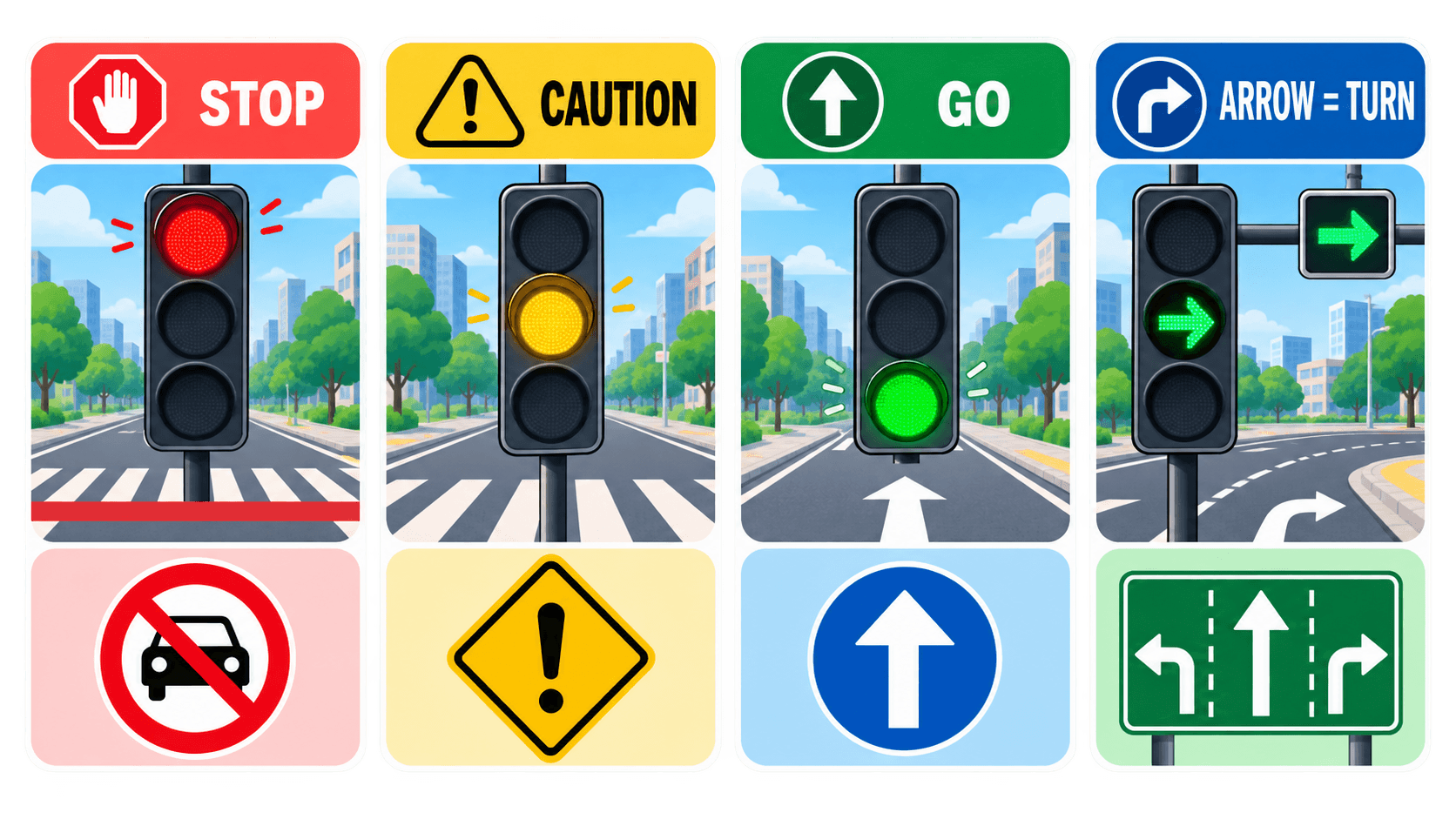
| Red light | Stop before the stop line, crosswalk or intersection. Do not enter on red. |
| Yellow light | Stop if you can do so safely. If you have already entered, clear the intersection carefully. |
| Green arrow | Move only in the arrow’s direction, while still watching for people and traffic. |
| Navigation | For driving routes, use Naver Map or Kakao Map. Google Maps does not provide driving navigation in Korea. |
Most Korean road symbols will feel recognizable to experienced drivers. The tricky part is the combination of early lane separation, controlled left turns, right-turn crosswalks and signal heads that apply to one specific movement. This guide gives visitors a practical first-drive briefing, not a substitute for the signs, signals and police directions at the scene.
Start with the road position and lane markings
Traffic keeps right in Korea. That is a major adjustment for visitors from the UK, Ireland, Australia, Japan, Hong Kong and other left-driving places: the steering wheel is on the left, traffic approaches from the opposite side, and a left turn crosses the centre of an intersection.
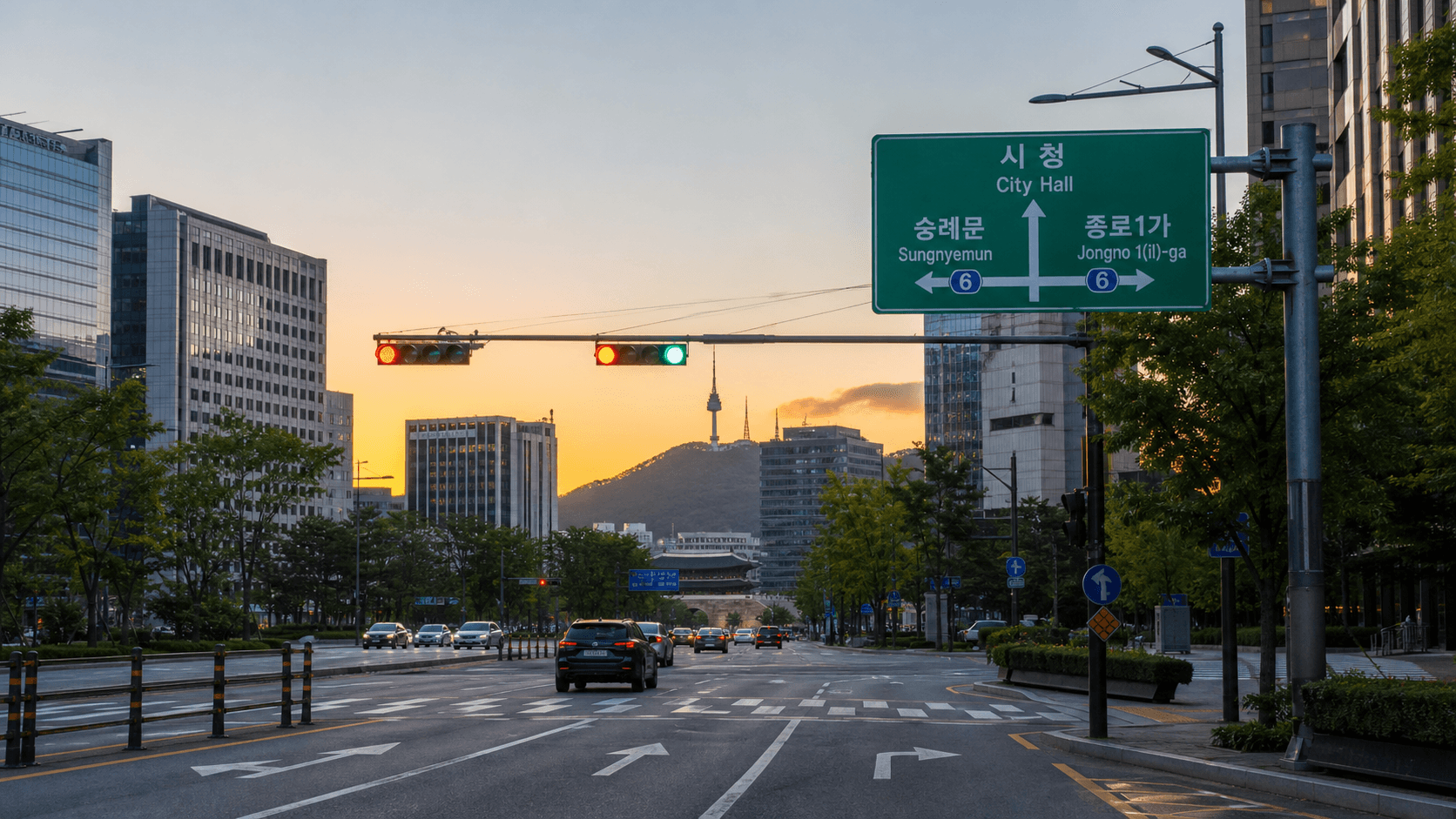
Choose your lane early. Korean city roads often split into dedicated lanes well before a junction, with arrows painted on the road and repeated signs overhead. Missing a lane is usually less costly than forcing a late merge. Continue safely, then reroute.
- White markings generally separate lanes moving in the same direction.
- Yellow centre markings separate opposite directions of travel.
- Solid lines, medians and painted islands are not invitations to cut across. Follow the marked path and make a later turn where permitted.
Traffic lights: read the movement, not just the colour
Red means stop
Stop before the stop line, crosswalk or intersection. A right turn on red is not automatic: come to a complete stop, obey any sign or lane signal, and yield to pedestrians, cyclists and traffic. If anything is unclear or anyone is crossing, wait for the next permitted movement.
Yellow means prepare to stop, not speed up
If you can stop safely before the line or crosswalk, do it. If you are already in the intersection when the signal changes, clear it carefully. Do not enter an intersection you cannot exit; blocking it creates danger and can trap cross traffic.
Round green and green arrows are different
A round green signal allows the movements permitted for your lane, but a left turn may still be non-protected and must not interfere with oncoming vehicles or pedestrians. A green arrow is clearer: proceed only in the direction of that arrow. Stay alert even with an arrow, because people may still be in a crosswalk or a vehicle may be clearing the junction.
Right turns and crosswalks: the habit that matters most
Right turns are where a familiar-looking intersection can surprise overseas visitors. Before turning, scan the crosswalk on both sides of the corner, check for cyclists, and follow the signal or sign controlling your lane. Keep your speed low and yield rather than trying to predict who will move first.
The Road Traffic Act requires drivers turning right to pay attention to pedestrians and bicycles that are stopping or proceeding according to the signal. In everyday terms: a clear-looking road does not make the crosswalk optional. Give people space and wait when necessary.
Left turns, U-turns and lane-control signals
Use the designated left-turn lane and wait for a green arrow when one is shown. Where the left turn is not protected, yield to oncoming traffic and pedestrians before completing it. Never start a turn only because the vehicle in front started moving.
Make a U-turn only where the road marking, sign or signal permits it. Some junctions have a specific U-turn pocket or a time/signal condition. A red X over a lane means do not enter that lane; a green arrow above a lane indicates the permitted direction of travel.
How to read Korean road signs at a glance
| What you see | Useful first interpretation | What visitors should do |
|---|---|---|
| Red circle or red border | Restriction, prohibition or limit | Slow down and read the symbol before proceeding. |
| Yellow warning shape | Hazard or changing road condition ahead | Reduce speed early and expect the condition shown. |
| Blue circular or rectangular sign | Required movement or driver instruction | Follow the arrow, lane or instruction rather than relying on a route guess. |
| Green direction board | Route, destination or road guidance | Use it with your navigation app; English and Romanized place names are common on main routes. |
Many major destination signs use Korean plus English or Romanization, and most regulatory signs are symbol-led. On a smaller road, though, do not assume every supporting notice will be translated. The symbol, road marking and signal take priority.
Other differences visitors notice
- Speed is in km/h. Watch the posted limit and road conditions. Do not convert from mph in your head while approaching a junction.
- Lane discipline is visual. Bus-only lanes, turn-only lanes and overhead arrows can change the correct route quickly. Let the navigation reroute instead of crossing markings late.
- Toll roads use Hi-pass lanes. In a rental car, ask whether a Hi-pass device is installed. If not, use a staffed or cash/card lane rather than a Hi-pass-only lane.
- Police directions and temporary control override the usual signal pattern. Follow officers and posted on-site instructions.
First-drive checklist
- Set Naver Map or Kakao Map before moving, and keep the phone mounted or let a passenger handle it.
- Review the first two turns while parked. The start of a trip is when wrong-lane decisions are most likely.
- Keep extra distance at the first few intersections and approach crosswalks slowly.
- If you miss a turn, stay calm. Continue straight and reroute; do not reverse, stop suddenly or cut across a solid line.
- For any collision, stop safely, check injuries, call 119 for ambulance/fire or 112 for police when needed, and contact the rental company immediately.
FAQ
Can I turn right at a red light in Korea?
Only after a full stop and only when the signal, signs and road conditions allow it. You must yield to pedestrians, cyclists and other traffic. When unsure, wait for green.
Does a green light always let me turn left?
No. A separate green arrow is the clearest authorization. Without it, a left turn may be non-protected, so you must yield and follow the lane marking and on-site control.
Are Korean road signs in English?
Main destination boards frequently include English or Romanized place names, while regulatory signs are usually visual. Learn the symbol and use navigation as a backup, not as a replacement for signs at the road.
Last checked: August 2026. Traffic rules and local restrictions can change. Check the current road signs and your rental company guidance before driving.
Official sources
- VisitKorea: Driving in Korea
- Korean Road Traffic Act (English)
- Enforcement Rule of the Road Traffic Act
- Korea Road Traffic Authority: signal guidance