Quick answer: Bringing a dog or cat to Korea is a document-and-identity process, not just an airline booking. Start with the Animal and Plant Quarantine Agency (APQA) rules and your departure country’s government animal-health authority. In most cases, Korea checks a readable microchip and an original government-issued or government-endorsed quarantine certificate. For many dogs and cats aged 90 days or older, a qualifying rabies antibody result is also part of the file.
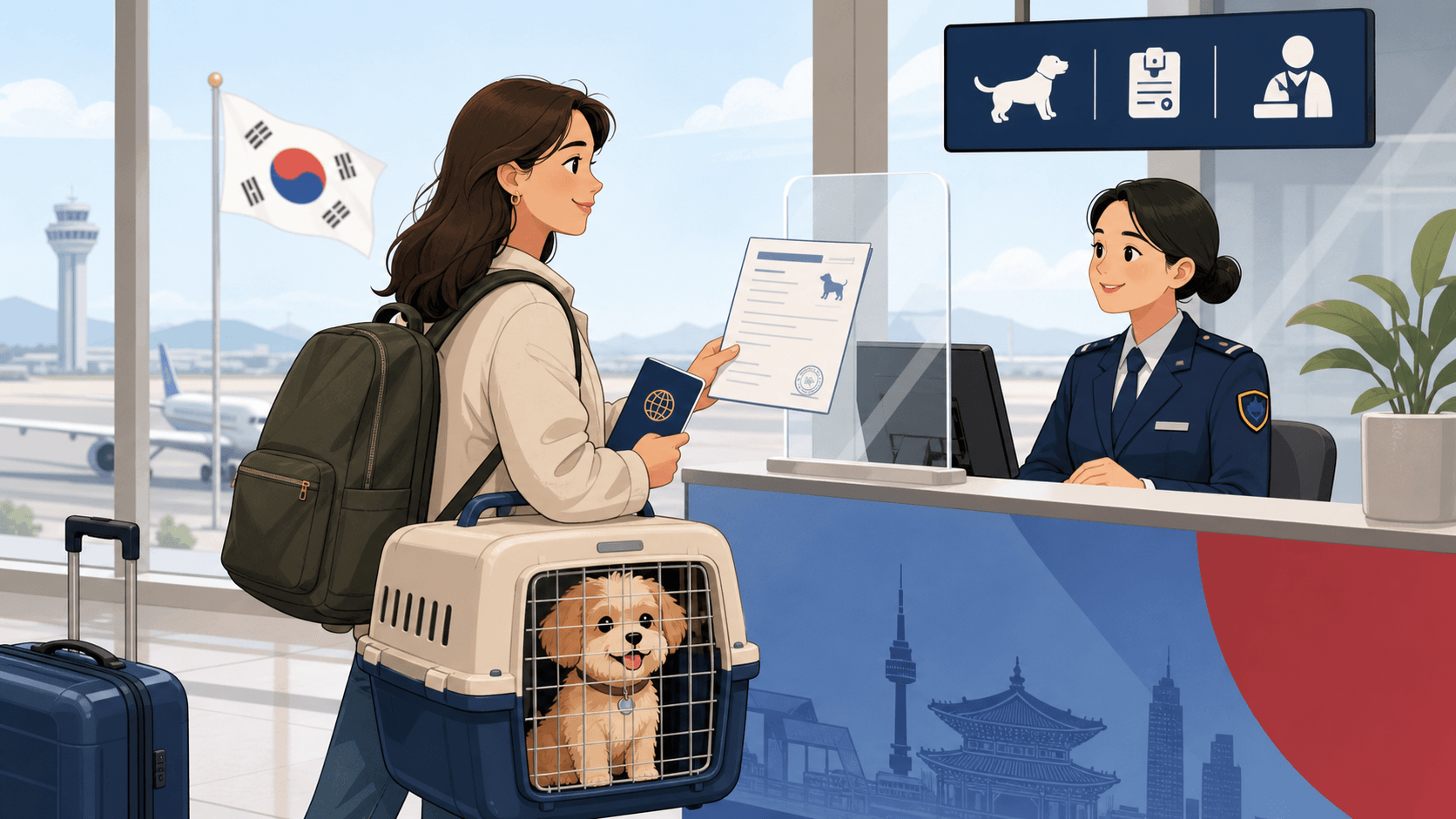
Start with the decision that changes your checklist
Do not use one generic online pet checklist. Your paperwork depends mainly on your pet’s age and whether Korea treats the departure country as rabies-free. The official certificate must identify your animal; names, dates and the microchip number need to agree across every document.
| Your situation | What to confirm before booking | What must still be in order |
|---|---|---|
| Dog or cat aged 90 days or older from a country that is not rabies-free | Whether the rabies antibody test, its date and the laboratory meet Korea’s current conditions. The published APQA guidance states a result of at least 0.5 IU/mL and a test taken 30 days to 24 months before shipment. | Microchip, official quarantine certificate, and airline approval. |
| Dog or cat under 90 days old | Ask the exporting government authority for the applicable certificate format. Do not assume a regular adult-pet timeline applies. | Microchip and official quarantine certificate. |
| Dog or cat from an officially rabies-free region | Confirm that the country is still recognized for your travel date and whether any country-specific certificate applies. | Microchip and official quarantine certificate. |
Important: Australia and Malaysia have additional certification conditions. Regulations and country classifications can change, so the final answer must come from APQA and the government animal-health authority where the trip begins.
Build the file in this order
- Ask the government authority in your departure country for Korea’s certificate process. A routine veterinary note alone is not necessarily enough. Korea requires a quarantine certificate issued or endorsed by the exporting country’s government authority.
- Confirm the microchip first. The chip number is how the pet is matched to the certificate and, when applicable, the antibody test. A correct test with a mismatched number does not solve the problem.
- Work backwards from the antibody-test window when it applies. APQA’s published guide says the sample for an eligible dog or cat must fall between 30 days and 24 months before shipment, and the result must be at least 0.5 IU/mL. Let the responsible government authority confirm the exact sequence for your case.
- Obtain the official certificate in the required format. Check every field against the microchip record before leaving the issuing office.
- Book the airline separately. Cabin, hold, carrier dimensions, seasonal heat restrictions, breed restrictions and routing are airline decisions. Clearing Korean quarantine does not guarantee carriage by a particular airline.
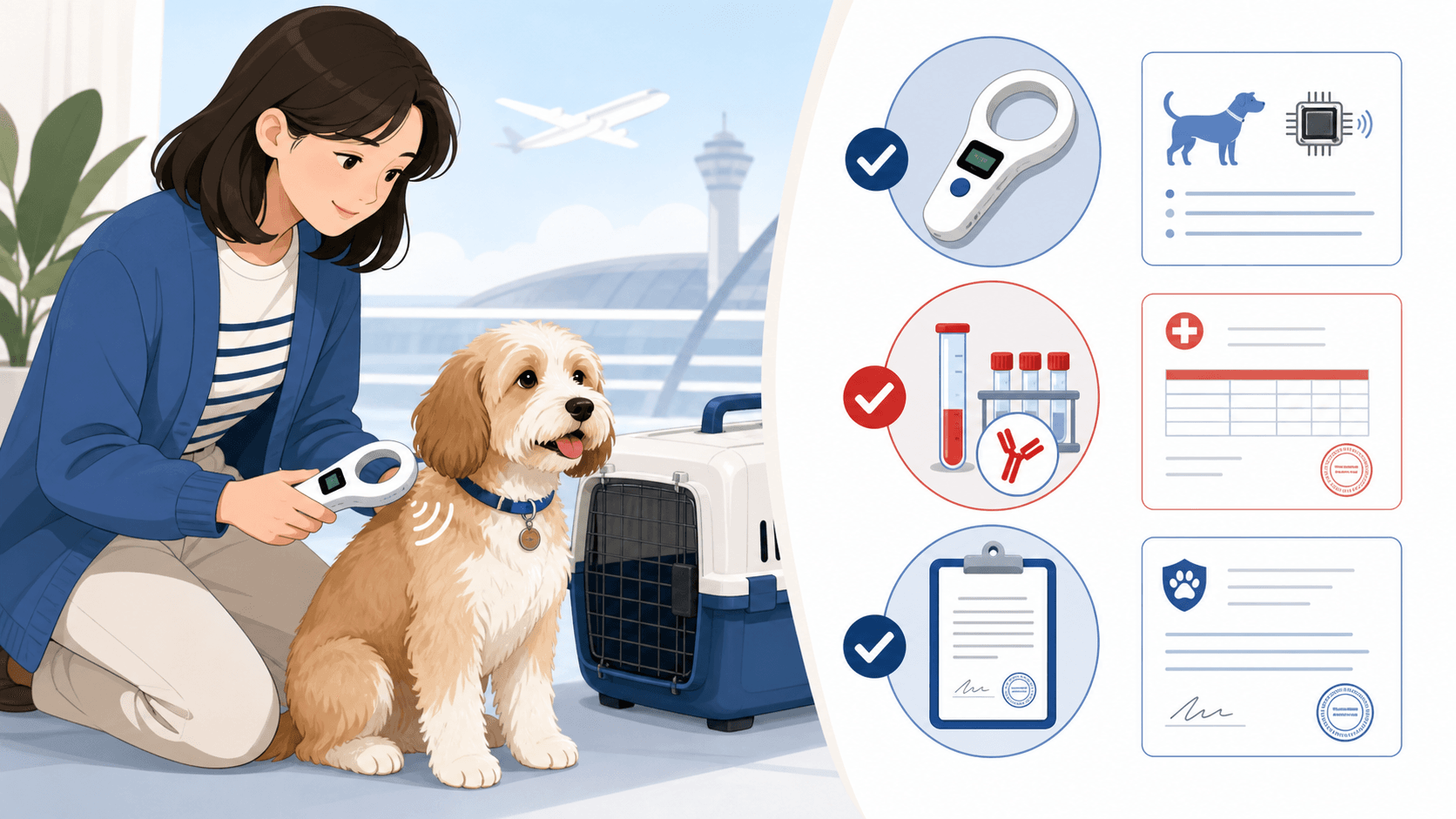
A practical timeline without risky promises
Several months before departure: contact the exporting government authority, check airline capacity for the flight, and find out whether laboratory testing will be needed. This is the stage where a late discovery can make a preferred flight impossible.
Before the certificate is issued: compare the chip number, vaccination or antibody-test evidence, pet identity details and owner information. Keep scans for yourself, but travel with the required original documents.
In the final days: reconfirm the airline booking, carrier rules and terminal instructions. Carry the original certificate in hand luggage, not in checked baggage.
Do not gamble on airport fixes: Incheon Airport states that pets without the required quarantine certificate can be subject to return. If a document does not satisfy Korea’s conditions, the pet can be held until the requirement is resolved.
What happens when you arrive in Korea?
- Declare the pet on the relevant quarantine or customs declaration given by the airline.
- Before passing through customs, go to the animal-quarantine officer with the pet and original documents.
- Present the official quarantine certificate and any required supporting records.
- Allow time for document review and clinical inspection.
If the requirements are met, inspection can be completed on arrival. Build time into the itinerary anyway: a pet arrival is not the moment to schedule a tight train connection, hotel check-in deadline or domestic flight.
What about rabbits, ferrets, birds and other pets?
Do not apply the dog-and-cat checklist to another animal. Incheon Airport lists different documentation and conditions for other pets, and some animals or routes can have separate restrictions. Contact APQA before you book transportation.
Do not forget other quarantine declarations
Declare plants, fruits, vegetables, seeds, flowers, soil-related items and animal-based foods. These are separate inspections from pet entry and can have their own origin- and product-specific restrictions.

Frequently asked questions
Is a veterinarian’s health certificate enough?
Not necessarily. Korea requires a quarantine certificate issued or endorsed by the government animal-quarantine authority in the country of departure. Ask that authority to confirm the current format for Korea.
Does every dog or cat need a microchip?
APQA’s published guide requires a permanent microchip for identification. The number must match the quarantine certificate and any supporting test record.
Can I prepare the paperwork at the airport?
No. Government certification, laboratory testing and airline approval can take time. Treat the airport as the place for inspection, not for completing the process.
Are airline rules the same as Korea’s quarantine rules?
No. You need to meet both. A compliant certificate does not override an airline’s carrier, route, cabin, cargo or breed policy.
Official sources and last checked
- Incheon Airport: Guidelines for accompanying pets
- Incheon Airport: Animal quarantine information
- Animal and Plant Quarantine Agency: dog and cat certification guide
Last checked: September 10, 2026. Requirements, recognized rabies-free regions, certificate formats and airline conditions can change. Confirm your exact case with APQA, your departure country’s government animal-health authority and the airline before buying a non-refundable ticket.