Quick answer: Exchange only the Korean won you need for your arrival day at Incheon Airport, then decide later whether a city exchange office, an ATM withdrawal or card payments suit the rest of your trip. The airport is the right place for convenience and a cash backup; it is not a reason to change your entire travel budget without comparing the live rate and your own card or bank fees.
The decision to make before you exchange
Most visitors do not need a large stack of cash the moment they land. Korea is highly card-friendly, but cash is still useful for a few situations such as small purchases, some market stalls, lockers and topping up a transport card. Your first job is to cover the first few hours comfortably, not to predict every expense for a two-week trip.
| Your situation | Most practical first choice | Why |
|---|---|---|
| Landing in daytime with a card that works abroad | Exchange a small amount, then compare city options later | You have cash for immediate needs without committing your full budget at an airport counter. |
| Landing late or with a delayed flight | Check the airport’s live 24-hour listings and keep a card or official taxi option ready | Not every counter or ATM has the same hours, even inside the same terminal. |
| Using an airport bus, AREX or a taxi to a hotel | Keep enough cash as a backup, but choose transport first | Do not exchange more than you need before you know how you will travel into Seoul. |
| Staying in Seoul for several days | Compare a licensed city exchange office, bank, ATM and card costs after arrival | A second decision made with time is usually better than a rushed airport decision. |
How much cash should you exchange at Incheon Airport?
There is no single amount that fits every traveler. Start with enough for food, transport, a small emergency buffer and any place where you expect to pay cash. Add more only if you know your card will not work, you are continuing to a cash-heavy destination or you have a clear reason to carry it.
Think in terms of a first-day buffer, not a complete spending plan. You can estimate ordinary trip costs with the Currency & Korea Prices tool, then decide how much KRW feels sensible before you exchange.
Official exchange counters: the simplest option
Incheon Airport’s official facility directory lists currency-exchange services operated by KB Kookmin, Hana and Woori Bank, with locations across Terminal 1 and Terminal 2. Counter hours and exact locations differ, so use the airport directory for your terminal rather than following a location saved from an old blog post.
Airport counters are legitimate and easy to find after a long flight. Their practical advantage is certainty: you can use an authorised service, receive Korean won immediately and continue to your hotel. The trade-off is that convenience may matter more than squeezing every possible won from your exchange.
Before handing over cash: look at the displayed rate, ask whether any fee applies and confirm the final KRW amount you will receive. Keep the receipt until you have counted the notes and completed your first day.
ATM withdrawals: useful, but check your own fees
An ATM can be a good alternative when your debit card supports overseas withdrawals and your bank’s fees are reasonable. The airport directory lists public ATMs as well as bank ATMs, but a machine accepting a foreign card is not a promise that your card issuer will approve a withdrawal or that the exchange rate will be best.
- Check your bank’s overseas withdrawal fee and daily limit before departure.
- Bring at least one backup card and store it separately.
- If the ATM offers a choice of currencies or conversion options, read the screen carefully before accepting. Your own bank may apply a different rate or fee structure.
- Do not keep trying a declined card repeatedly. Use another authorised machine, a bank counter or a second card instead.
Terminal 1 vs Terminal 2: what changes?
Both terminals have official financial services, but the floor, exit number and operating hours can differ. Terminal information also matters for your onward transport: the time you spend walking to a counter is not the same as the time you need to reach AREX, an airport bus or the official taxi line.
Check your airline’s terminal before landing. Then search the Incheon Airport facility directory for the live counter or ATM nearest to you.
What if you arrive at night?
Late arrival is where a backup plan matters more than an ideal exchange rate. The airport directory includes some services marked 24 hours, but not every counter is open around the clock and locations can change. Before your flight, save your hotel’s Korean address, a working payment card and the official airport transport links.
If a suitable exchange counter is closed, do not accept an unofficial offer. Incheon Airport explicitly warns that unregistered currency-exchange business is prohibited. Use an authorised bank counter or ATM when available, and use the official taxi stand or live late-night transport information if public transport no longer fits your arrival.
Airport exchange vs Myeongdong vs a bank
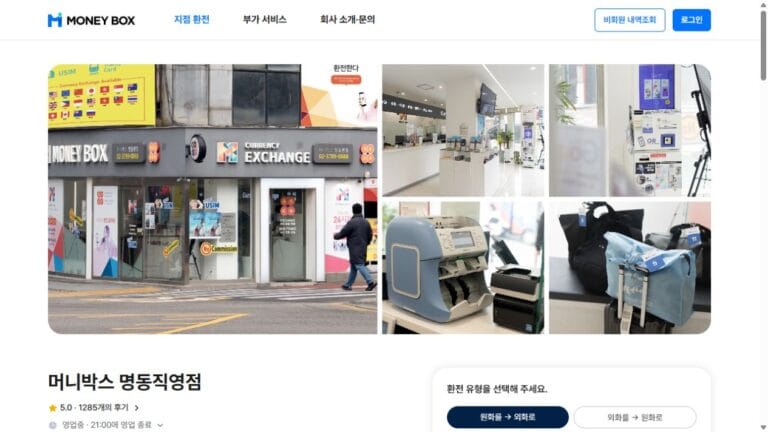
Each option solves a different problem. The airport gives you certainty on arrival. Myeongdong can be useful when you are already in central Seoul and can compare several licensed offices. A bank can be a dependable fallback outside major tourist areas, though branch hours and currency availability vary.
For a wider comparison, read Where to Exchange Money in Korea: Airport, Myeongdong or a Bank?. The sensible pattern for many visitors is simple: exchange a modest arrival amount at the airport, then choose the rest after you know how much cash you actually use.
Do not forget the trip from the airport
Cash is only one part of your arrival plan. If you are choosing between rail, bus and taxi, use Incheon Airport to Seoul: AREX vs Airport Bus vs Taxi. For a taxi, airport-bus desk or hotel transfer, keep your destination in Korean as well as English with the Korean Address Converter.
Incheon Airport currency exchange checklist
- Confirm whether you are landing at Terminal 1 or Terminal 2.
- Decide on a first-day cash buffer rather than exchanging your entire budget.
- Use official bank counters or authorised ATMs only.
- Check the displayed rate, any fee and the final KRW amount before confirming.
- Keep your card, passport and exchanged cash in separate secure places.
- Save the receipt and the official airport directory for your terminal.
FAQ
Is it better to exchange money at Incheon Airport or in Seoul?
The airport is better for immediate convenience and a first-day cash buffer. Seoul can be better for comparing more options once you are settled. The right choice depends on your arrival time, card fees and how much cash you actually need.
Are there ATMs at Incheon Airport?
Yes. Incheon Airport’s facility directory lists public and bank ATMs, but locations, hours and foreign-card acceptance can differ. Check the live directory for your terminal.
Can I exchange money at Incheon Airport after midnight?
Some airport financial services are listed as 24 hours, but do not assume every counter is open overnight. Check the official directory for your terminal before relying on a specific location.
Should I exchange all of my cash at the airport?
Usually no. Exchange enough to begin the trip comfortably, then compare authorised options in Seoul if you need more.
Official sources and last checked
- Incheon International Airport: Convenience and Public Facilities
- Incheon International Airport: authorised currency exchange operators
Last checked: September 4, 2026. Exchange rates, counter locations, ATM availability and hours can change. Confirm them through the official airport directory before travel.